The Book
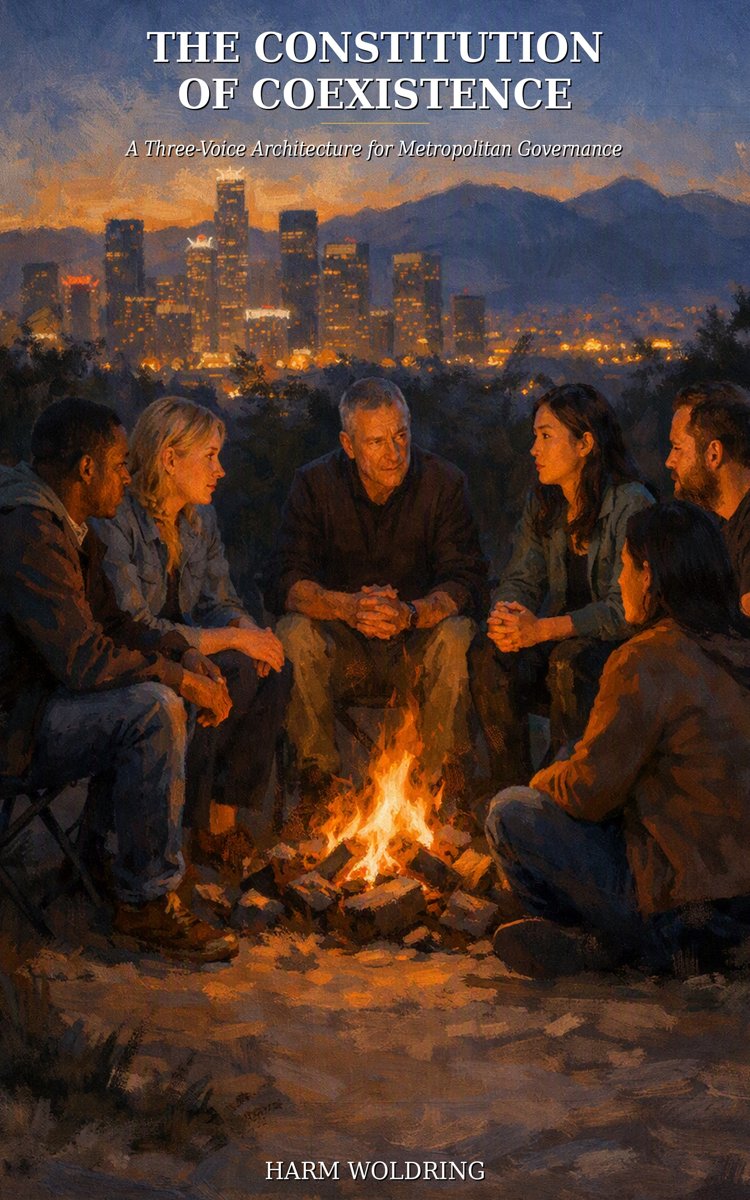
The Constitution of Coexistence
A Three Voice Architecture for Metropolitan Governance
Millions of us share the same watersheds, housing markets and transit corridors. None of them stop at a city boundary. The way we govern them does.
Buy on Amazon · Paperback and Kindle
The opportunity
Metro Vancouver is a dog with twenty-one heads, each pulling toward its own bowl. Its body was put together seven generations ago, without the forethought Indigenous peoples would have brought to the table, and everyone who lives here inherits its shortcomings.
I know it from the inside. I have lived in six of its twenty-one cities, and my siblings have lived in at least six more.
The proposal
This book does not offer a new ideology or another layer of administration. It offers a constitution for a region that already exists, built on three sources of legitimacy that each speak from their own foundation: people, place, and Indigenous jurisdiction.
Almost nothing in it is new. It takes practices already proven elsewhere and puts them together in a way no region has tried.
The population voice
The Borough Councils
Each Borough Council speaks for the people of its Borough with one voice, a position it works out in its own caucus before it enters the shared chamber.
The territorial voice
The Regional Council
Delegates carry their Boroughs' mandates and weigh each decision by place: the watersheds, infrastructure and environmental systems no single Borough boundary contains.
The third voice
The Indigenous Borough
Indigenous jurisdiction held as its own legal order, present from the start of every decision, working alongside the other two voices as neighbours and partners in a neutral arena.
How a decision is made
Every decision moves through three phases, so that agreement is discovered rather than bargained for.
1
Initiation
All three voices receive the same record at the same moment, so none of them gets a head start.
2
Review
Each voice forms its own position, in its own space and in its own way.
3
Resolution
The positions are brought together to see whether real agreement already exists. When it does, that agreement is given legal effect.
The cycle draws on the Haudenosaunee practice of letting each party form its position independently before entering a shared space. A neutral Regional Chair protects the process and has no stake in how it ends.
Paying for it
Each Borough keeps the taxes raised on the land inside its boundaries. Only the growth in commercial and industrial taxes, from the day the Borough forms, is shared across the region by population and need. The water, sewer and other regional levies residents already pay stay in place, funding the Regional Council and its administration.
No community gives up what it has already built, and every community gains a stake in growth wherever it happens to land. Regions elsewhere have run growth-sharing like this for more than fifty years.
Who it is for
Anyone who lives in a metropolitan region and has wondered why ordinary things take so long to get done.
Councillors, planners and students of governance will find a working design they can test and argue with. So will Indigenous leaders weighing what genuine constitutional standing could look like inside a region.
A note from the author
I wrote this book from outside Indigenous communities, and I do not speak for them. It grew from a simple aim: a region where every voice is at the table from the beginning, working as neighbours and partners. The book is built to leave room for what only Indigenous governance itself can bring to it.
Harm Woldring
Buy on Amazon · Paperback and Kindle